
What separates google ads landing page designs that generate exceptional conversion rates from those that drain advertising budgets without delivering results? The answer lies in understanding the critical elements that transform casual clicks into committed customers, creating a seamless bridge between your paid advertisements and business objectives.
Successful google ads landing page designs require more than aesthetic appeal—they demand strategic thinking that aligns user intent with business goals. When visitors arrive from Google Ads, they carry specific expectations shaped by your advertisement’s promise, and your landing page has mere seconds to fulfill those expectations while guiding users toward conversion.
Understanding Google Ads Landing Page Design: Key Concepts and Definitions

Core Design Definitions
A Google ads landing page is a standalone web page designed with one primary goal: converting visitors who click on your paid ads. Unlike your website’s homepage or blog post, these pages focus exclusively on driving users toward a specific desired action, whether that’s email sign ups, purchases, or lead capture.
Key terminology includes:
- Landing page conversion rate: The percentage of visitors who complete your desired action
- Quality Score: Google’s metric evaluating ad relevance and landing page experience
- Call to action (CTA): The button or link guiding visitors toward immediate action
- Message match: Alignment between ad copy and landing page content
Design Element Relationships
Effective google ads landing pages create a seamless transition from ad click to conversion through interconnected design elements:
- Hero section → establishes clear value proposition → builds trust
- Visual elements → guide user attention → focus on call to action
- Social proof → reassure visitors → reduce friction → boost conversions
- Mobile optimization → enhances user experience → improves conversion rates
Why Landing Page Design is Critical for Google Ads Success

Well-designed landing pages directly impact three crucial metrics that determine your Google Ads profitability:
Quality Score Impact
Google rewards relevant, user-friendly landing pages with higher Quality Scores, which can reduce your cost per click by 15–50% depending on your baseline score — with Quality Scores of 8–10 achieving the upper range of savings. Note that industry-wide CPCs are trending upward in 2025 (averaging $5.26, up ~13% YoY), making Quality Score optimization even more critical for maintaining efficient ad spend. Pages that load quickly and match ad intent consistently outperform generic destinations.
Conversion Rate Performance
Dedicated, optimized landing pages consistently outperform homepages and generic product pages for paid traffic. The 2025 Google Ads average conversion rate across industries sits at 7.52%, while Unbounce’s Q4 2024 benchmark of 41,000+ pages places the median at 6.6% — with top-performing pages exceeding 10%. The actual improvement from optimization varies widely by industry, baseline performance, and targeting quality.
ROI Optimization
High converting pages reduce your customer acquisition costs while maximizing revenue per visitor. Dedicated landing pages aligned to specific ad groups improve ROAS by eliminating message mismatch and reducing wasted clicks — though the exact improvement varies by industry, campaign structure, and optimization maturity. Rather than citing a single figure, focus on tracking your own baseline and measuring incremental improvements through A/B testing and conversion rate optimization.
11 Elements of Top Performing Google Ads Landing Page Designs
1. Message Match and Headline Consistency
The foundation of effective google ads landing page designs starts with perfect message alignment between your advertisement and landing page headline. This consistency eliminates confusion and reinforces the visitor’s decision to click your ad.
Your headline should mirror the language, tone, and promise made in your Google Ads copy. When users see familiar phrases and terminology, they experience cognitive ease—a psychological state that increases trust and reduces bounce rates. This alignment becomes particularly crucial for B2B SaaS companies like Michael Thompson’s startup, where complex product features require clear, consistent messaging across all touchpoints.
Key Message Match Elements:
- Use identical or similar keywords from your ad copy
- Maintain consistent tone and language style
- Address the same pain point or benefit
- Include specific numbers or promises from the ad
Consider the visitor’s journey: they searched for a specific solution, found your ad compelling enough to click, and now expect your landing page to deliver on that promise. Any disconnect between ad copy and headline creates friction that can immediately derail conversion potential. Message mismatch between ad copy and landing page headlines is one of the leading causes of elevated bounce rates. While the exact impact varies, industry best practice benchmarks a healthy landing page bounce rate at under 40% — and poor message alignment can push bounce rates significantly above this threshold, directly undermining Quality Score and conversion performance.
Effective headlines also incorporate your primary keyword naturally while addressing the specific pain point your Google Ads campaign targets. This approach satisfies both search engine optimization requirements and user expectations, creating a foundation for higher Quality Scores and improved ad performance.
2. Above-the-Fold Value Proposition
Your value proposition must be immediately visible without scrolling, clearly communicating what makes your offer unique and valuable. This element becomes critical for google ads landing page designs because paid traffic represents users actively seeking solutions.
A compelling value proposition answers three fundamental questions within seconds:
- What do you offer?
- How does it benefit the user?
- Why should they choose you over competitors?
For established companies, this messaging must balance innovation with trustworthiness, highlighting AI-powered personalization while maintaining security assurances.
The most effective value propositions use specific, measurable benefits rather than generic claims. Instead of “improve your business,” successful landing pages specify “increase conversion rates by 35%” or “reduce customer acquisition costs by 50%.” This specificity resonates particularly well with data-driven professionals like Alex Thornton, who seek concrete evidence of potential improvements.
Value Proposition Components:
- Clear headline stating your main benefit
- Supporting subheadline with additional context
- 2-3 bullet points highlighting key advantages
- Visual element reinforcing the message
Visual hierarchy plays a crucial role in value proposition presentation. Use contrasting colors, strategic white space, and typography variations to ensure your core message stands out against competing page elements.
3. Compelling Call-to-Action Design and Placement
Your call-to-action (CTA) represents the conversion moment where visitors become leads or customers. Effective google ads landing page designs treat CTAs as the primary focal point, using design elements that naturally draw attention and encourage action.
Color psychology significantly impacts CTA performance. High-contrast colors that stand out from your page’s color scheme typically generate higher click-through rates. Orange and red buttons often perform well due to their urgency-inducing properties, while green can suggest safety and progress.
CTA Optimization Checklist:
- Use action-oriented language (“Get,” “Start,” “Download”)
- Create visual contrast with surrounding elements
- Make buttons large enough for easy clicking
- Place primary CTAs above the fold
- Include secondary CTAs throughout the page
The language within your CTA button affects conversion rates significantly. Action-oriented phrases like “Get Your Free Analysis” or “Start Your 14-Day Trial” outperform generic terms like “Submit” or “Click Here.” For CMOs seeking strategic design partnerships, CTAs might emphasize consultation value: “Schedule Your Brand Strategy Session.”
Multiple CTA variations throughout your landing page should maintain consistent messaging while adapting to different content contexts. A primary CTA might focus on immediate conversion, while secondary CTAs could offer lower-commitment alternatives like newsletter subscriptions or resource downloads.
4. Social Proof and Trust Indicators
Trust becomes paramount when users arrive through paid advertisements, as they may be unfamiliar with your brand. Effective google ads landing page designs incorporate multiple trust signals that build credibility and reduce conversion anxiety.
Types of Social Proof:
- Customer testimonials with photos and company names
- Case studies showing specific results
- Client logos and partnership badges
- Review ratings from third-party platforms
- Industry awards and certifications
- Money-back guarantees
Customer testimonials provide powerful social proof, particularly when they include specific results and come from recognizable companies or individuals. For B2B audiences, testimonials from similar company sizes or industries carry additional weight.
Video testimonials often outperform written reviews because they’re harder to fake and create stronger emotional connections. Short, focused testimonials addressing specific benefits or common objections can be particularly effective for conversion optimization.
Trust badges, security certifications, and industry awards serve as credibility indicators that reassure visitors about your legitimacy and expertise. These elements become especially important for financial services companies, where security concerns significantly impact conversion decisions.
5. Mobile-First Responsive Design

Mobile traffic represents a significant portion of Google Ads clicks, making responsive design essential for google ads landing page designs. However, mobile optimization extends beyond simple responsiveness—it requires rethinking user experience for smaller screens and touch interactions.
Mobile Optimization Priorities:
- Fast loading speeds (under 3 seconds)
- Touch-friendly button sizes
- Simplified navigation menus
- Thumb-friendly element placement
- Compressed images and optimized media
- Single-column layouts for easy scrolling
Mobile-first design prioritizes the most critical information and actions for smaller screens, then scales up for desktop viewing. This approach ensures your core message and conversion elements remain effective regardless of device type.
Touch-friendly design elements improve mobile conversion rates significantly. Buttons must be large enough for easy tapping, forms should minimize typing requirements, and navigation should accommodate thumb-based interaction patterns. These considerations become especially important for e-commerce companies, where mobile conversion optimization directly impacts revenue.
Progressive enhancement allows your landing page to function effectively across various devices and connection speeds. This approach starts with a basic, functional version and adds enhanced features for capable devices, ensuring accessibility for all visitors.
6. Streamlined Form Design and Lead Capture
Form design significantly impacts conversion rates, as each additional field creates friction that can prevent completion. Effective google ads landing page designs balance information collection needs with user convenience, requesting only essential information for initial conversion.
Form Optimization Strategies:
| Form Length | Conversion Impact | Use Cases |
|---|---|---|
| 1-2 fields | Highest conversion rates | Newsletter signups, free trials |
| 3-5 fields | Moderate conversion rates | Demo requests, consultations |
| 6+ fields | Lower conversion rates | Detailed assessments, enterprise sales |
Progressive profiling allows you to gather additional information over time rather than overwhelming visitors with lengthy forms. This approach works particularly well for B2B companies where relationship building occurs through multiple touchpoints.
Form Design Elements:
- Clear, descriptive field labels
- Inline validation with helpful error messages
- Logical field ordering and grouping
- Smart defaults and auto-fill capabilities
- Progress indicators for multi-step forms
- Security indicators for sensitive information
Multi-step forms can improve completion rates for longer information collection requirements. Breaking complex forms into logical sections with progress indicators helps users understand the commitment required and maintains momentum through the completion process.
7. Page Loading Speed and Performance
Loading speed directly affects both user experience and Google Ads Quality Scores, making performance optimization crucial for google ads landing page designs. Slow-loading pages increase bounce rates and reduce conversion potential, while fast-loading pages improve user satisfaction and ad performance metrics.
Performance Optimization Techniques:
- Image compression and modern formats (WebP, AVIF)
- Minified CSS and JavaScript files
- Content delivery network (CDN) implementation
- Browser and server-side caching • Critical rendering path optimization
- Asynchronous loading of non-essential scripts
Image optimization represents one of the most impactful performance improvements. Compressed images, appropriate file formats, and responsive image sizing can dramatically reduce loading times without sacrificing visual quality.
Modern image formats like WebP and AVIF offer superior compression compared to traditional JPEG and PNG formats. Implementing these formats with fallbacks for older browsers can significantly reduce image file sizes while maintaining visual quality.
Performance monitoring tools provide ongoing insights into loading speed variations and identify optimization opportunities. Regular performance audits help maintain optimal speeds as content and functionality evolve over time.
8. Clear Visual Hierarchy and Information Architecture
Effective visual hierarchy guides visitors through your landing page content in a logical sequence that supports conversion goals. Strategic use of typography, color, spacing, and layout creates a clear path from initial attention to final action.
Visual Hierarchy Elements:
- Size variations (headlines > subheadings > body text)
- Color contrast for emphasis
- Strategic white space around important elements
- Consistent alignment and grid systems
- Directional cues (arrows, pointing gestures)
- F-pattern and Z-pattern layout considerations
Typography hierarchy uses size, weight, and color variations to establish content importance and reading flow. Headlines should be significantly larger than body text, with subheadings providing intermediate emphasis levels.
White space serves as a powerful design element that improves readability and focuses attention on key page elements. Adequate spacing around important elements like CTAs and value propositions helps them stand out and reduces visual clutter.
Color psychology influences user behavior and emotional responses. Consistent color schemes create professional appearances, while strategic accent colors can highlight important elements like buttons and key benefits. For established companies requiring brand transformation, color choices must align with broader brand strategy while optimizing conversion performance.
9. Benefit-Focused Content and Feature Explanation
Content strategy for google ads landing page designs must focus on benefits rather than features, helping visitors understand how your solution addresses their specific challenges. This approach requires understanding your target audience’s pain points and presenting solutions in terms of outcomes rather than capabilities.
Content Structure Framework:
- Problem identification and pain point acknowledgment
- Solution presentation with clear benefits
- Feature explanations connected to specific outcomes
- Objection handling and risk reduction
- Social proof integration throughout content
- Clear next steps and conversion encouragement
Feature explanation becomes necessary for complex products or services, but should always connect to specific benefits. For example, instead of simply listing “AI-powered analytics,” explain how this feature “reduces manual reporting time by 75% while improving decision-making accuracy.”
Benefit vs. Feature Examples:
| Feature | Benefit |
|---|---|
| 24/7 customer support | Never worry about downtime affecting your business |
| Advanced encryption | Keep your customer data completely secure |
| One-click integrations | Set up your system in minutes, not weeks |
| Real-time analytics | Make informed decisions instantly |
Addressing objections proactively within your content reduces conversion barriers. Common concerns might include pricing, implementation complexity, or security considerations. By acknowledging and addressing these concerns directly, you build trust and remove obstacles that might prevent conversion.
Scannable content formatting accommodates online reading behaviors where users typically scan before reading in detail. Short paragraphs, bullet points, numbered lists, and strategic bold text help important information stand out during initial page scanning.
10. Strategic Use of Multimedia Elements
Multimedia elements can significantly enhance google ads landing page designs when used strategically to support conversion goals rather than simply adding visual interest. Videos, images, and interactive elements should reinforce your value proposition and guide visitors toward conversion.
Effective Multimedia Types:
- Product demonstration videos (30-90 seconds)
- Customer testimonial videos
- Interactive calculators or assessments
- High-quality product or service images
- Infographics explaining complex processes
- Before-and-after comparison visuals
Product demonstration videos provide powerful conversion tools, particularly for complex solutions requiring explanation. Short, focused videos that highlight key benefits and address common questions can improve understanding and build confidence in your solution.
For UX directors, seeing actual interface demonstrations can be more compelling than written descriptions. Video optimization for web delivery ensures fast loading and broad compatibility through compressed files and multiple format options.
Interactive elements like calculators, assessments, or configurators can increase engagement while providing value to visitors. These tools help users understand potential benefits specific to their situation, creating personalized experiences that improve conversion likelihood.
High-quality images should support your messaging and create emotional connections with visitors. Avoid generic stock photos in favor of authentic images that reflect your actual products, services, or team members.
11. Analytics Integration and Conversion Tracking
Comprehensive analytics integration enables continuous optimization of google ads landing page designs based on actual user behavior and conversion data. Proper tracking setup provides insights necessary for improving performance and maximizing return on advertising investment.
Essential Tracking Elements:
- Primary conversion goals (form submissions, purchases)
- Micro-conversions (video views, scroll depth, time on page)
- Traffic source attribution and campaign performance
- User behavior patterns and interaction data
- A/B test results and statistical significance
- Conversion funnel analysis and dropout points
Conversion tracking should extend beyond simple form submissions to include micro-conversions that indicate user engagement and intent. These might include video views, document downloads, or time spent on specific page sections.
Key Performance Metrics:
| Metric | Good Performance | Optimization Priority |
|---|---|---|
| Conversion Rate | 6-10% (varies by industry) | High |
| Bounce Rate | Under 60% | High |
| Page Load Speed | Under 2.5 seconds | High |
| Time on Page | 2+ minutes | Medium |
| Scroll Depth | 75%+ reach fold | Medium |
Heat mapping and user session recording tools provide qualitative insights into how visitors interact with your landing page. This data reveals friction points, identifies optimization opportunities, and validates design decisions based on actual user behavior rather than assumptions.
A/B testing capabilities allow systematic improvement of landing page elements through controlled experiments. Testing different headlines, CTAs, layouts, or content approaches provides data-driven insights for optimization decisions.
How Passionate Agency Transforms Google Ads Landing Page Performance
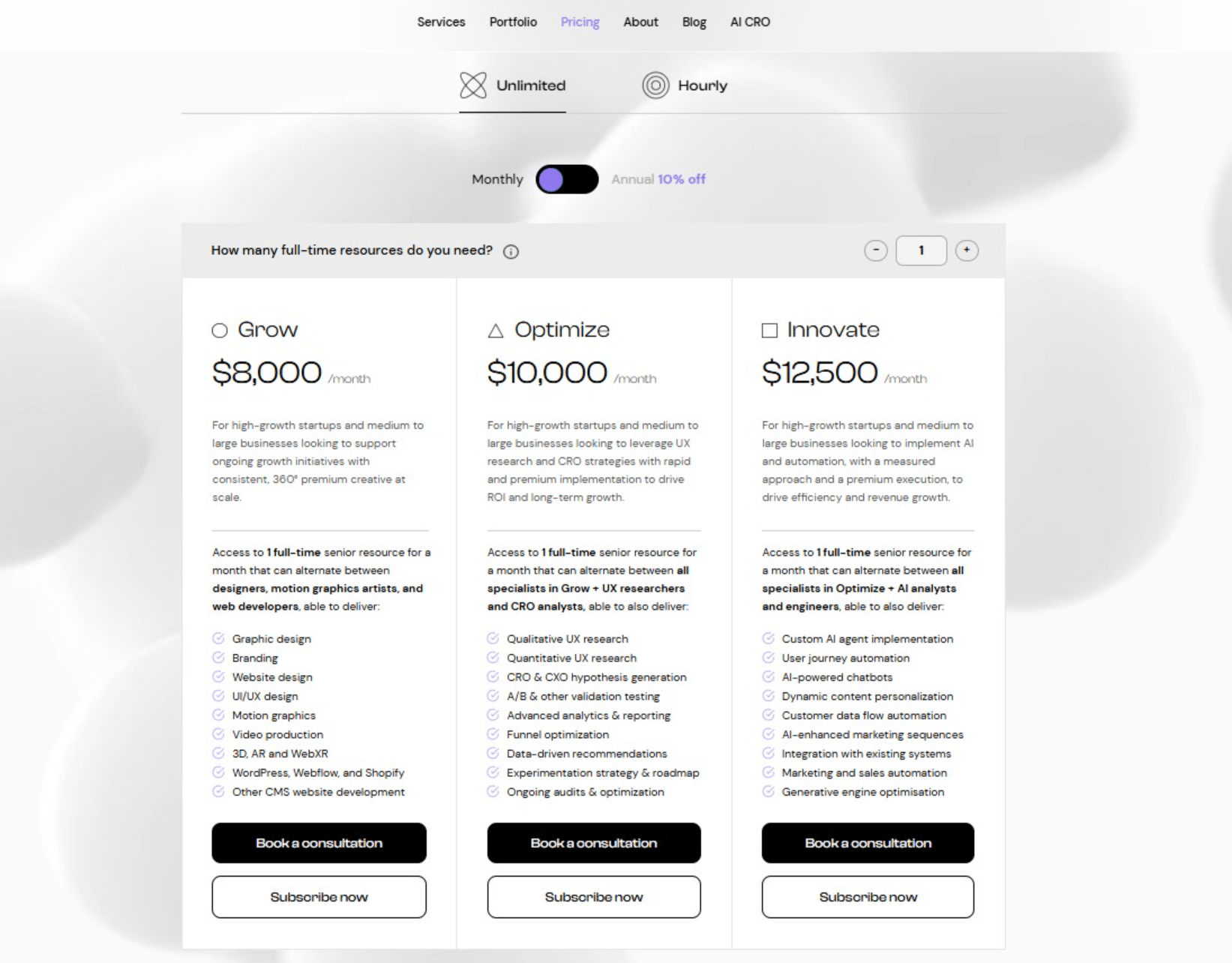
Creating high-converting google ads landing page designs requires expertise across multiple disciplines—from user experience design and conversion optimization to analytics implementation and ongoing testing. Passionate Agency specializes in delivering comprehensive unlimited premium creative services that address all eleven elements discussed above through our integrated approach to digital marketing and design.
Our Service Packages:
| Package | Monthly Cost | Annual Cost | Ideal For | Key Features |
|---|---|---|---|---|
| Grow | $8,000 | $7,200 | Startups & Medium Businesses | Full-time senior designer, branding, web design, UI/UX |
| Optimize | $10,000 | $9,000 | Growth-Focused Companies | Everything in Grow + UX research, CRO, A/B testing |
| Innovate | $12,500 | $11,250 | Enterprise & AI-Forward Companies | Everything in Optimize + AI implementation, automation |
Our Optimize package provides the perfect solution for e-commerce organization seeking conversion breakthroughs. This package includes access to UX researchers and CRO analysts who specialize in:
- Qualitative and quantitative user research
- A/B testing and experimentation strategy
- Advanced analytics and funnel optimization
- Data-driven conversion improvements
The Optimize package delivers comprehensive conversion rate optimization through systematic testing and data analysis. Our team has helped clients achieve measurable conversion rate improvements through systematic testing and optimization.
For established companies requiring comprehensive brand transformation alongside conversion optimization, our Grow package provides full-time senior resources capable of handling graphic design, branding, website design packages, and UI/UX development while ensuring brand consistency across all touchpoints.
Startups like B2B SaaS company benefit from our ability to create cohesive brand identities while implementing conversion-focused landing page designs. We help startups and agencies compete effectively against established players through premium white label web design services, strategic design, and messaging that communicates unique value propositions clearly.
For forward-thinking organizations like financial services company, our Innovate package combines all optimization capabilities with AI implementation and automation, including:
- Custom AI agent implementation
- Dynamic content personalization
- User journey automation
- AI-powered chatbots and customer interactions
Measuring Success and Continuous Improvement
Successful google ads landing page designs require ongoing optimization based on performance data and user feedback. Establishing clear success metrics and implementing systematic improvement processes ensures long-term conversion growth and competitive advantage.
Optimization Process:
- Monthly performance reviews and trend analysis
- Quarterly strategic assessments and goal adjustments
- Continuous A/B testing of key page elements
- User feedback collection through surveys and interviews
- Competitive analysis and industry benchmarking
- Documentation of successful strategies and lessons learned
Key performance indicators should include conversion rate, cost per conversion, bounce rate, average session duration, and Quality Score improvements. These metrics provide comprehensive insights into both user experience and advertising efficiency.
Regular performance reviews should analyze trends, identify optimization opportunities, and prioritize testing initiatives. Monthly reviews allow sufficient data collection while maintaining optimization momentum necessary for competitive advantage.
User feedback collection through surveys, interviews, or feedback tools provides qualitative insights that complement quantitative analytics data. Understanding why users convert or abandon provides context for optimization decisions and reveals opportunities that data alone might miss.
Summary
Effective google ads landing page designs integrate multiple elements working together to create seamless conversion experiences that bridge the gap between advertising promises and business results. From message match and compelling value propositions to mobile optimization and comprehensive analytics, each element contributes to overall performance success while supporting broader marketing objectives.
The most successful organizations recognize that landing page optimization requires ongoing attention and systematic improvement rather than one-time implementation. By implementing these eleven elements and maintaining focus on continuous optimization, businesses can significantly improve their Google Ads return on investment while building stronger relationships with potential customers.
